George Washington, John Adams and Thomas Jefferson debated how to handle Barbary pirates, a historical parallel to today’s Iran and Strait of Hormuz.
Writing to his trusted ally, the Marquis de Lafayette, after the War of Independence, George Washington believed it “the highest disgrace” that Americans were “tributary to such banditti who might for half the sum that is paid them be exterminated from the Earth.” Those “banditti” were the Barbary pirates of North Africa who preyed on American merchant ships in the Mediterranean, enslaving their crews and endangering the nascent republic’s economy.
But lacking the naval power to protect its foreign trade, the United States paid monetary “tribute” to Barbary, inducing it not to attack. The practice sparked a visceral debate between John Adams, who favored giving in to extortion over using force, and Thomas Jefferson, who preferred to “raise ships and men to fight the pirates into reason [rather] than money to bribe them.”
Today, two-and-a-half centuries after declaring independence, the United States is grappling with many of the same questions that challenged its Founders. To what degree should Americans defend the freedom of navigation through a vital international waterway? Should they stand up to or pay off a Middle East power threatening it? Instead of the Mediterranean, at stake today is the Strait of Hormuz, and in place of Barbary is the Islamic Republic of Iran.
The ayatollahs’ worldview is almost identical to the pirates’. In a 1786 meeting with Jefferson and Adams in London, Tripoli’s ambassador Ambassador Sidi Haji Abdul Rahman Adja insisted that Barbary was sovereign in the Mediterranean and that no nation could traverse it without paying a massive toll.
NO RETREAT AT HORMUZ — IRAN MUST NOT CONTROL THE WORLD’S ENERGY LIFELINE
He further explained “that all nations who should not have acknowledged their authority were sinners, that it was their [the Muslims’] right and duty to make war upon them wherever they could be found, and to make slaves of all they could take as Prisoners.” Any Muslim killed in battle, Abd al-Rahman assured the two stunned Americans, “was sure to go to Paradise.”
The encounter convinced Adams that Americans must avoid what they now call endless war with the Barbary states. “We ought not to fight them at all, unless We determine to fight them forever,” he wrote. Such a conflict, moreover, would be “too rugged for our People to bear,” and, given the loss to U.S. shipping, rising insurance rates, and the vast national debt, entirely too costly. America had no choice, Adams counseled, but to continue to pay tribute. Better to send the pirates “one Gift of two hundred Thousand Pounds” than to risk “a Million [in trade] annually.”
Jefferson, though, reached a radically different conclusion. “An angel sent on this business… could have done nothing” to pacify the pirates, he reported, and opposed further efforts to assuage them monetarily. Americans, moreover, with their “erect and independent attitude,” would never succumb to blackmail. Peace with Barbary, Jefferson held, was only attainable “through the medium of war,” a course which would also deter other hostile powers. “It will procure us respect…and respect is a safeguard to interest.”
TRUMP MAY HAVE WON A STRATEGIC PAUSE IN IRAN. NOW COMES THE HARD PART
Jefferson nevertheless realized that all talk of war was frivolous as long as the newly independent America lacked a navy. All negotiations with Barbary should cease, he recommended, until the country adopted “measures… which may correct the idea… of impotency in the federal government.” Needed was a credible military option.
The question that divided Adams and Jefferson – whether to fight or bribe the pirates – became critical in 1789 in the arguments for and against a Constitution. Unless “these” United States became “the” United States under a single federal government, the taxes could not be raised to build a navy, and without gunships, America was incapable of battling Barbary. “Weakness will invite insults,” James Madison maintained. “The best way to avoid danger is to be in [a] capacity to withstand it.”
CLICK HERE FOR MORE FOX NEWS OPINION
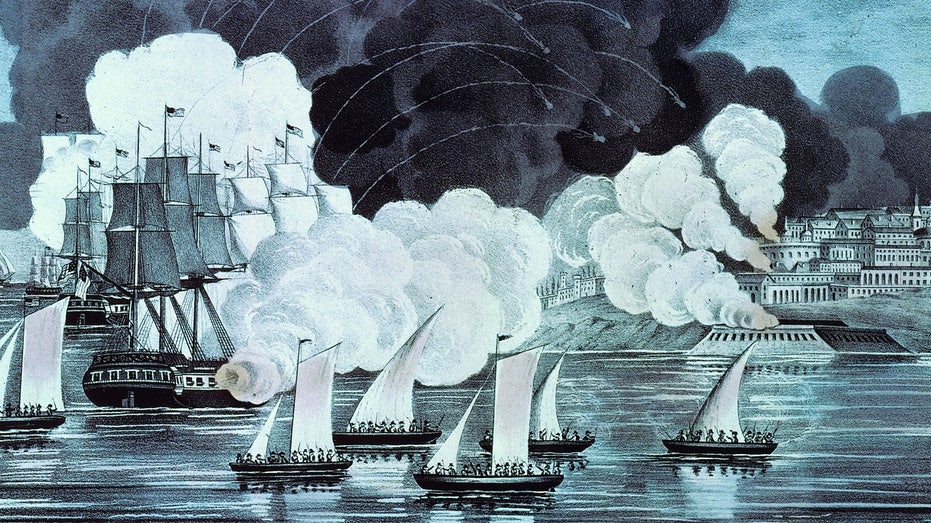
The federalists won and the pirates consequently lost. Under its new Constitution, the United States authorized the construction of six frigates especially designed to fight close to Barbary’s shallow shores. What ensued was America’s first foreign and longest war, lasting until 1815. Only then was Barbary decisively defeated, and American merchantmen guaranteed safe passage through the Mediterranean.
The victory was a source of immense national pride. The country erected its first war monument, to the triumphant Barbary War, on the campus of the U.S. Naval Academy in Annapolis. No less than 17 American cities were named for the hero of that campaign, Commodore Stephen Decatur. And the Marines still sing of their landing “on the shores of Tripoli.”
These testaments serve to remind Americans, now approaching their country’s 250th birthday, of the ways in which the Founders faced the threats to free navigation posed by an extremist Middle Eastern regime. Though initially divided over whether to financially incentivize or militarily vanquish that power, the country’s first leaders decided on the latter course and prevailed.
The Trump administration, by contrast, has pursued both policies, first waging war against Iran and now inducing it with the possible infusion of billions. Still unknown is whether Iran – unlike Barbary – can be trusted to comply with the agreement and whether the peace once won by the United States can be replicated today.